

Some Coaching Concepts

The coaching profession has exploded in recent years, diversifying across many different fields and industries. All of these people are dedicated to helping others achieve their goals, improve aspects of themselves or their business, or move forwards from where they are today.
The following are concepts around what coaching is and the powerful results it can influence in the workplace:
- What is coaching?
- How does coaching work?
- About Managing and Coaching!
- Coaching Results
- Selecting a Coach.
-
I. What is coaching?
“Coaching is an ongoing partnership that helps clients produce fulfilling results in their personal and professional lives. Through the process of coaching, clients deepen their learning, improve their performance, and enhance their quality of life.”
In the coaching relationship, a safe environment is created for each person to take the risks they need to take and to be courageous. It is in this space that clients will be able to approach their lives with curiosity, interest, power, creativity, and choice.
Coaching unlocks a person’s potential to maximize their own performance. It helps the client to learn rather than teaching them. Building awareness and responsibility is the essence of good coaching.
The coach is the client’s partner and champion for SUCCESS.
Coaching is…
- a one-on-one personal relationship
- a dynamic and powerful partnership
- convenient and flexible
- about guiding the process so that the client finds their solutions
Coaching is not…
- therapy
- about persuading, arm twisting, or convincing
- about fixing anyone
- about the coach being an expert and having the answers
- consulting service
-
II. How does coaching work?
The Guiding Principles of Coaching are:
1. CLARITY:
- Clarifying thoughts, beliefs, intentions, and direction
- What do you want in your life?
2. ALIGNMENT:
- Focusing
- Gathering resources
- Identifying and designing action steps that are aligned with your intentions
- Lay out a plan to get there
3. ACTION:
- Taking the steps to get there
- Action steps with accountability and support
-
III. About Managing and Coaching:
Coaching and managing are two very different activities. One has to do with directing, the other has to do with teaching.
Managing is all about telling, directing, authority, immediate needs, and a specific outcome. Coaching involves exploring, facilitating, partnership, long-term improvement, and many possible outcomes.
The manager focuses primarily on strategy and managing the flow of work. He positions the players and decides who pitches and when. The coach has to guide the players on how to perform managers instructions and guide them to success.
In business, we have to be both coaches and managers. To lead effectively, we need to know when to wear which hat.
Managing involves a more directive, task-oriented style that should only be used under certain conditions. It usually produces the best results in a crisis situation, when someone has never done the task before, or when they have little or no confidence in their ability to get it done.
Coaching works best for developmental purposes, especially when you have a team of competent professionals already performing at a reasonably high level. Once you define winning for your organization, team members may need your guidance and support. But in most cases they shouldn’t need direction.
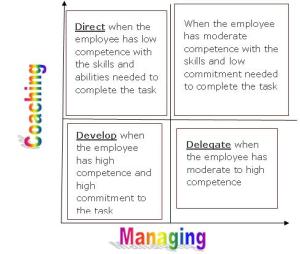
Knowing when to direct, delegate or develop is critical to managerial effectiveness. Determine which style is appropriate based on the taskat hand rather than the individual. Often, people will need a combination of styles depending on the complexity of the task assigned, their experience with the task, and the competency levels required to complete it with excellence.
Direct when the employee has low to moderate competence with the skills and abilities needed to complete the task. Be sure to define excellence (what, how and when), and provide specifics (templates, examples, etc.) so the person can achieve the desired outcome. Direct when a person:
- Is new in a role
- Is new to the company
- Is new to the client/customer
- Has new job responsibilities or tasks
- Has new ways of working
Delegate when the employee has moderate to high competence. Again, define excellence so both sides have clarity around the goal. Then let the employee determine the approach they will take and keep you informed as to their progress. Ask questions and provide direction and specific support when necessary. Delegate when a person has:
- Some experience in the role
- A track record or competence
- A sensitive task or client
- Confidence in their abilities
- Similar ways of working
Develop when the employee has high competence and high commitment to the task. Then define excellence and get out of the way! Give plenty of recognition for successful completion of the task. Then determine the person’s next challenge. Develop when the person:
- Has extensive experience
- Has demonstrated evidence of competency
- Has experienced similar clients or task sensitivities
- Is growing new competences
- Is trying new approaches
Sometimes we have to coach and sometimes we have to manage. But the more time we can spend delegating and developing, the more effective we’ll be.
In a work environment, the role of a manager-coach can be described as: “achieving results and excellence through others rather than personally taking care of things, and focusing on developing employees in order to achieve business results rather than micro-managing their every move”. Adopting coaching as a management style requires managers to help other people to enhance their own performance. It’s about supporting people to learn instead of telling them what the answers are. The mindset of the manager-coach is to create an environment that promotes learning, independent thinking and opportunities to contribute. The manager-coach doesn’t want to be seen as a solution provider. Rather, they want to be seen as a facilitator, paving the way for team members to achieve their results. Coach Managers are a role model for others. They are excellent listeners and communicators, providing perspective and encouragement whilst setting high standards and expectations.
Managers should make coaching behaviors part of what they do by:
- Stop thinking about employees as people that need to be controlled or managed.
- Focus on developing the strengths of each employee rather than managing merely for results.
- Endorse effort and growth instead of pointing out failures or errors.
- Create an environment where people want to work with.
- Be unconditionally constructive.
- Stop making all the decisions.
- Stop providing solutions.
- Listen, listen, listen.
-
IV. COACHING RESULTS:
Personal coaching can be for many reasons and purposes. Listed below are just a few of the personal growth experiences that happen in coaching.
a. Life Vision and Enhancement:
Fulfill life-long dreams and experience true happiness
b. Personal Transitions:
Embrace change as an opportunity for growth and fulfillment
c. Spiritual Growth:
Explore and deepen your relationship with your Higher Power and your True Essence
d. Relationships:
Deepen and enrich your relationships with the significant people in your life
e. Grief/Loss:
Healing and growth through painful experiences of loss – breakthrough in breakdown
f. Self Care:
Honor and nurture yourself through healthy choices and habits
-
V. Selecting a Coach
Finding the right career coach for your needs and personality can be a intimidating task. However, it is of the greatest importance to find someone that is not only qualified, but qualified to address your needs. Although there is no such profession in our Middle East market and it is hard to find a professional person, we will give some outlines to make sure your career coach is qualified and can deliver what you need, here are 9 tips to consider.
1. Experience
Does the coach have work experience comparable to yours? It is estimated that about 75% of self-proclaimed career coaches actually have little-to-no experience in the workplace and have only been trained in life coaching. In universities professors play the coaches role successfully with their post graduate students.
2. Credentials
Choose a coach who belongs to trade organizations like the Worldwide Career Coach Association (WCCA). Select a qualified person who attended formal training and adheres general standards of professionalism.
3. Credibility
Select someone that has a solid and quality reputation in the industry. Your coach should be active and visible in the industry, publishing books and articles in major media, as well as presenting new ideas at professional conferences.
4. Testimonials
Request that the coach provide you with references from past clients.
5. Methods
Some coaches insist that you come to their location in person; others will agree to meet with you at a local coffee shop or even work with you by phone or by email. If you would prefer a particular meeting location or method, make sure the coach you’re considering will at least discuss your request.
6. Goals
Any decent career coach should be able to help you find and establish your professional goals. However, before meeting with anyone, take some time to determine your own goals and potential milestones.
7. Consultation
Your first meeting is vital in establishing the extent to which your potential coach and you are compatible (or not). Don’t forget: this an individual with whom you will be revealing personal aspects and details of your life.
8. Guarantee
Inquire as to what sort of guarantee the coach provides.
9. Fees
Career coach rates vary substantially according to location and type of industry


 Human Performance Improvement for you
At this time I am going to do my breakfast, once having my breakfast coming yet again to read other news.
Incredible points. Outstanding arguments. Keep up the great spirit.