

CASTING QUALITY CONTROL BY ADJUSTING THE PERFORMANCE OF MANPOWER ABILITIES ON FOUNDRY FLOOR

An Abstract of the Thesis Submitted to
Faculty of Engineering, Alexandria University
June 1969
As one of the requirements for the degree of
Master of Science in Engineering
By
IBRAHIM MOHAMED MORSY
B Sc. Production Engineering
The main target of introducing a quality control program in an industry is to prevent and minimize defective products turned out, i.e.; to guarantee products which will meet the specifications demanded by the consumer and save the name of the producer. This will eliminate waste, in labor time, labor efforts and materials which will happen due to rework, consumer returns, and or scrapping the rejects. All this will be reflected on the high reduction of the final production cost. The main tool in such a program is the quality control charts, on which the process inspection data can be plotted to give in “real time” response, to provide ”on line” control.
The casting manufacturing process is very complicated, which makes the application of such programs difficult, as it will deal with a lot of different materials (sands, binders. Refractory metals, fuels, fluxes …) equipment (mixers, furnaces, ramming machines, patterns, flasks …), and processes (pattern making. molding, melting, pouring, fettling …). Also, foundries in Egypt are usually job shops with production run as short as one piece.
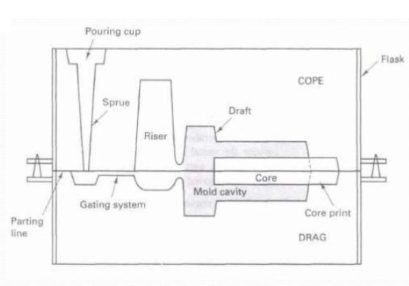
The above facts don’t invalidate the use of statistical quality control programs in foundries. There are now many foundry shops which apply successfully quality control, for the aim of preventing defects, through:
- Design analyses,
- Preproduction planning, and
- Adjusting production capabilities and specifications.
They are pre-established with its working ranges for the characteristics to be controlled. The control of any variable that deteriorates with time and affect the quality characteristic of interest is so easy by recording its wear history on quality control charts:

Foundries, as well as any other industrial Situation, involve a combination of Materials, Machines, Tools and Men. Most of quality control programs applied on foundries, put on its consideration materials, tools and machines only as source of variation that reflect on product quality, ignoring the most important source which is “the man” as most control problems with the other variables would disappear if man performed his tasks properly and consistently. In very rare cases, an employee motivation and improvement program is used, considering the direct proportionality between moral and productivity, putting the responsibility of performance on the individual and assuming that defects are assignably caused by people.
Man is a complex organism, which makes his system of variables the most difficult item to control. Man’s decisions and actions directly affect the extent of variability of the quality of the product, especially if it is metal casting, as craftsmanship is still playing an important role.
In small foundries the hand molder still checking his hand tools, patters, equipment, sand and even metal, as he ram the mold, puts gating system, rams cores or inspects it before assembling the mold, supervises pouring, and shakes the casting out. So there can be no consistent reliability in a product except through reliability in the man who makes it.
It is high time to correct the oversight of forgetting the human variable in quality control, by applying the following suggested program.
On the assumption that the major part of responsibility of producing a defect free casting lies on the shoulders of the hand molder (in small foundries which are widely spread in Egypt) can be implemented by applying the following steps:
- Making a complete analysis for the abilities of each working labor.
There are fifty five human abilities that has been chosen which are correlated with the production of casting; these abilities were divided into the following eleven main categories:
- Feeling abilities,
- Physical abilities,
- muscles abilities,
- Psychomotor abilities,
- Perception abilities,
- Mental abilities,
- Memory abilities,
- Social abilities,
- Production abilities,
- Technical abilities and
- General interests.
There are three different methods are used to receive measured values for these abilities;
- Clinical, examination for feeling, physical and muscles abilities.
- Questionnaire designed to measure labor general interests, social, production and technical abilities.
- Psychological tests for measuring psychomotor, Perception, mental and memory
A psychometric test battery was designed and implemented to measure these abilities which consist of fourteen separate tests. Before putting these psychological tests in its final form as standard measuring technique they pass through several steps, and assessed by two significant experiments.
- The first experiment is to measure the test battery reliability
Reliability of a test battery is the calculated coefficient of correlation between the results of two successive trials under the same condition on a standardization sample chosen from foundry labors.
The coefficient of reliability was found 0.88 as an average for the whole test battery which is satisfactory.
- The second experiment is to measure the test battery validity
By calculating the coefficient of correlation between the “mark” or value obtained for each ability for each man in the standardization sample, with a chosen criterion (which was taken as the financial grade), the average coefficient of validity for the measured abilities was found to be 0.87, which is satisfactory, or even high than expected (due to the small number of the sample size).
The “mark” given per ability for each man, indicates qualitatively, to what extent he can perform with this ability. This mark can be measured on an arbitrary scale divided from 1 to 5, ascending with the increase of the amount of the ability to be measured. This scale is obtained as a result of putting the information taken from clinical investigation, questionnaire, and psychological tests; under five separate norms. A human abilities psychograph for each foundryman can be drawn indicating the “mark” of his different abilities by personnel department, and send to production planning office.
- For a new casting to be produced in the foundry, the planning office studies should give the results of the following studies;
- The correct method for its manufacture,
- Its needs from raw materials, machines, tools… etc. and
- Its needs from human capabilities. The results of this study should be given with certain defined marks taken on the same arbitrary scale (from 1 to 5) for the involved human abilities. This can be obtained from a designed questionnaire tables for measuring the required abilities, based on different parameters of the casted piece and divided into five separate norms. This can be plotted also on a similar psychograph of the needed human abilities for the production of a casted piece.
- By comparing the results of item “II” with those of item “I” for the existing labors:
It will be easy for the planning staff to suggest the most suitable man to perform a certain casted part/s. Both production and quality control sections must receive this result.
- The quality control man in on the foundry floor should first collect data about the defects generally appear during production:
He should select the more frequent ones for control, and analyse these mostly appearing defects to know the causes of each and whether these causes are due to any of the parameters of human abilities or that of other sources. Knowing to what extent each of the parameters affects the appearance of each defect, a factor which indicates the effect of human abilities in the appearance of each of the defects, can be obtained. For example this factor was found to be; 0.8 for blow holes, 0.75 for shrinkage, 0.77 for inclusion and 0.9 for shifts.
- On receiving the psychograph for each of the labor and the casted part:
The quality control man will find out a factor which indicates the effect of the important human abilities with respect to the appearance of each defect, in this specific casted piece.
- The two parameters of the quality control chart used are;
- The same scale of the performance of the human abilities from zero to five as in “I”, and
- The time in days, shifts or fraction of a shift. The upper control limit is the average of the human abilities of either of the labor or of the casted piece (taking only the bigger value). The range of control is the difference between the average of production abilities needed when calculated on maximum and minimum conditions.
- As production runs on, the percent of defective products for each type of defect for each labor is determined and multiplied by the previously obtained factor;
(The effect of this man abilities on the appearance of each defect, in the production of this casted piece), and summing up for all defects, we will get the deviation of the performance of the labor abilities from the upper controlling limit. The labor performance index for this period is the difference between this deviation and the upper control limit. This index is plotted on the quality Control chart.
- It has been proved, through this work that the degree of performance of human abilities decreases according to the severity of the environmental conditions to which the labor is exposed, as heat, noise, dust, and lack of light. There is also a lot for variables which work for the deterioration for these abilities; these will make the labor performance index obtained from the previous item decrease by time.
- Before this index reaches the lower controlling limit, corrective action should be taken.
This can take place by changing the labor working’ place, improving environmental conditions, give a rest pause, increasing his motivation for work, …
The main results obtained from this research are;
(a) Shifting some variable causes of variation in casting quality from being random, uncontrollable to be assignable and can be controlled.
(b) The process of choosing the suitable labor to perform certain work is based now on scientific standard basis, and not depending on the foreman judgment which may be based on bias, personal prejudice, or appraisal criterion.
(C) A psychometric test battery was developed and implemented to measure qualitative values of foundry labor abilities which consist of fourteen separate tests with approved reliability by a coefficient of correlation which was found 0.88 which is satisfactory. Also, the coefficient of validity of the test battery abilities was found to be 0.87, which is satisfactory.

 Human Performance Improvement for you