

Basics of Ferrous Metallurgy

Definition:
Metallurgy is the study of
- Mining
- Refining
- Altering the properties & preparing for use
From the all known metals we are going to discuss changing the properties of:
Gray iron & Steel: In chemical terms, steels has carbon content from 0.05% to 1.70% while Gray iron has carbon from 1.7% to 4.0% .
Plain carbon steels
Low carbon steels (1005 – 1025)
Contains from 0.05% carbon to 0.25% carbon
Medium carbon steels (1062 – 1050)
Contains from 0.26% carbon to 0.50% carbon
High carbon steels (1051 – UP)
Contains from 0.51% carbon and up
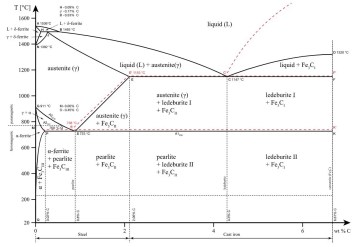
It’s clear that Carbon content has a great effect on the final properties of the produced iron, i.e. we should study first the effect of carbon content in iron at different temperatures. To study the iron carbon relations at different temperatures, we have to refer first to the famous Iron-Carbon Diagram:
Mechanical Properties of Iron and Steel
We should have gotten the idea on how plain carbon steels are numbered from the previous examples. The following are the most important properties of plain carbon steel:
- Hardness
- Wear or Abrasion Resistance
- Resistance to Peening
- Resistance to Breaking
- Resistance to Bending
- Resistance to Chock Loading
- Brittleness
Now, let’s get down to cases and concentrate on changing the mechanical properties of steel through proper heating and cooling. That’s what heat treatment is: It’s the proper heating and cooling of steel to change its properties.
The regime of heating and cooling is designed according to the carbon content of the steel to be treated, which will assign the lower critical temperature (LC) and the upper critical temperature (UC) “please refer to the following curve”:
xx
Here are the properties that can be changed by heat treatment:
- Hardness
- Wear resistance.
- Abrasion resistance
- Resistance to peening “denting”.
- Resistance to breaking
- Resistance to bending
- Resistance to shock loading
- Brittleness
One of these properties listed above is very special. If you change this one property, it will affect all the others. It is the HARDNESS.
But what’s hard and what isn’t? Before discussing the above effects, we must have a way to talk about hardness. So, we will pause for a moment and study Rockwell hardness ratings
As the harder steel is the less likely to be ‘dented’ by a blow (that’s peening). Since the harder the steel the less it will dent, we can rate the hardness of a piece of steel by denting it under controlled conditions. If the “denting force is always the same, the bigger the dent, the softer the material.
The Rockwell system pushes a cone-shaped indenter into the steel under a fixed weight “load”. The depth of the indentation is measured and translated into a rating number. The way these rating numbers are set up, soft materials have low numbers and hard materials have high numbers.
Hardness Measure Example
R C 54
ROCKWELL SCALE RATING
The scale is the same (A, B, C or D), the smaller the number, the softer the steel.Rc 33 is smaller than Rc 43; therefore, Rc 33 is softer than Rc 43.Now then, we live in a fast world and in a fast world things are abbreviated.Rockwell C 33 is abbreviated to Rc 33, Rockwell C 54 is abbreviated to Rc 54, Rockwell B 89 is abbreviated to Rb 89
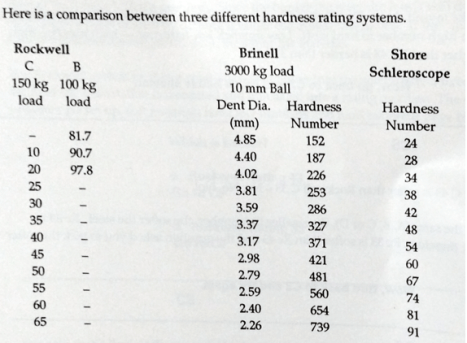
Now that we have a way to express comparative hardness, we can begin to study the effect of hardness on all other properties previously listed.
When a piece is made harder; it’s more wear resistant and doesn’t “dent” easily. A change in hardness will affect Abrasion resistance and resistance to peening. Hardness is a desirable property to produce parts which must resist wear and abrasion. WEAR happens between two parts are in contact with relative motion and load. The best example of parts which must resist ABRASION are all ground engaging tools (GET) which, depending upon the size of the machine with which they are used and the soil conditions, they should be through hardened to Rc45. Note that ground engaging tools are also subjected to chock loads, if they were through hardened to, say, Rc65, they would be too brittle for their application. This will create the need to have a softer core behind the hardened case. Once the abrasive materials had worn through the hard case, wear would occur with extreme speed.
TOUGHNESS is the ability to absorb shock loads, and BRITTLENESS is the opposite of Toughness.
WEAR is the process of denting between two surfaces, and breaking it off to microscopic pieces of the material, this need:
- CONTACT
- LOAD
- RELATIVE MOTION
CASE HARDENING:
It’s a way of producing a wear resistance piece by hardening its outer layer only
TEMPERING
It’s a way of softening a hard piece of steel slightly to toughen it greatly, also it increase its wear resistance, toughness and also release its internal stresses produced during heat treatment.
Proper Heating above UC is hardening, lower LC is tempering
Proper Cooling depends on the speed of cooling or its speed:
- Quenching —> very fast
- Water spray
- Agitated water
- Agitated oil
- Agitated air
- Still air –-> Very slow
Hardenability:
Higher hardness ability, means greater case depth. The only way to improve case depth is through ALLOYING.
Hardness Potential:
Hardness Potential –à The maximum surface hardness that a steel can achieve. The way to increase hardness potential is to increase CARBON content
Beside resistance to wear or abrasion, and resistance to peening, and also resistance to shock loading a change in hardness will also affects:
- Resistance to breaking
- Resistance to bending
- Increased Brittleness and lose of ductility.
- Yield Strength (The load a piece is able to carry, before stretching beyond the spring back point measured by PSI)
- Tensile Strength (the load a piece can carry before breaking, measured by PSI)
- PSI = Pound per Square Inch
st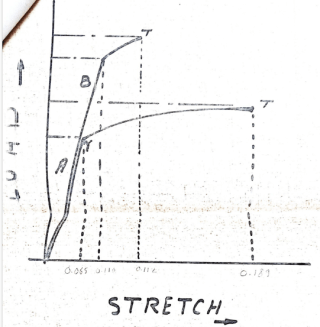
This curve shows two different samples
-
Sample “A” more ductile, point “Y” is its yield strength and point “T” is its tensile strength.
-
Sample “B” is more brittle, it has higher yield point “Y” and strength “T” but with less Stretch.
An increase in hardness means an increase in yield strength and less stretch or elongation.
Materials that don’t stretch or bend much between yield point and breaking point are called BRITTLE material, as BRITTLENESS is the opposite of Toughness which is the ability to absorb shock loads.
HI-ELECTRO Hardening:
It’s a processes that employs induction heating or by resistance to current flow using special furnaces..
PREPARING IRON AND STEEL FOR USE
Using any of the following Forming Processes:
- Casting
- Forging
- Rolling
They will be covered in another articles.
Good Luck and, Great Success
Ibrahim


 Human Performance Improvement for you