

PRODUCTION OF NODULAR CAST IRON BY INJECTION OF MAGNESIUM POWDER

Research Paper Submitted to
First Metallurgical Conference
Cairo 12-15 June 1971
By
MORSY I.M., KHALIL S.E. And VISHKARIEV A.P.
EL-TABBIN METALLURGICAL INSTITUTE FOR HIGHER STUDIES
SUMMARY
Factors influencing the production of nodular graphite cast iron in Cairo Foundries of El-Nasr Casting Company were investigated. The applied technique was the injection process, which was done by introducing pure magnesium powder into the melt through a graphite tube using nitrogen as a carrier gas.
Due to the high sulfur content of the produced cast iron during the period of investigation, some trials for desulphurization were carried out, prior to treatment with magnesium. It was shown that better desulphurization can be obtained by increasing the blast temperature of the cupola, or by ladle treatment. The addition of flurospar or increased amount of line stone in cupola charge did not give a sizable effect.
The injection of 4 kg of magnesium powder per one ton of cast iron gave a 100% spheroidal graphite cast iron. The recovery of magnesium that has been obtained was found 27.5% irrespective to the high sulfur content in the base cast iron to be treated.
At the present time it is easier to obtain nodular cast iron as the sulfur content is low.
INTRODUCTION
The engineering needs to a high strength, tough, machine-able, and cheap cast-able products, creates the use of the nodular or spheroidal graphite structure form of cast iron, as it possesses these properties. Some typical examples are: diesel and compressor construction, ship building, agricultural equipment, automotive parts, high pressure water pipes, ingot molds, valves, fittings, and rolling stock.
Production of ductile iron in the world, already has passed two million tons per year, and is expected to reach 20 million tons eventually. As an example the total production of ductile iron in U.S.A. during the year 1964 was 478,418 tons, and during the year 1969 was 1,285,770 tons, which shows an increase of 170% during 6 years. Despite that progress, there is no one best way to make ductile iron under all circumstances (Ref.#3).
Although the actual causes of spheroidal graphite formation still are not explained fully, numerous metallurgical treatment processes have been developed, to produce ductile iron castings of satisfactory quality. Morrogh (Ref.4) has suggested that the element responsible for the spheroidal form of graphite may be present as an adsorbed or surface layer on the graphite particles. This explains the need cf small quantities of magnesium, causing an increase interfacial energy between molten iron and graphite (Ref. 5).
Stippen (Ref. 6), suggested that magnesium recovery depends on carbon and silicon, as represented by the equation:
Mg = 0.01C(1+0.4Si)
Grichovich (Ref. 7). He referred to the thickness of casting (R), as an effective factor on magnesium recovery, as follows:
Mg = 0.008(0 + Si) + 0.0015 R
However when calculating such empirical equations, it did not give always a real result with practice (Ref. 8),
So, the recovery of magnesium and quality of ductile iron produced depends on:
- Base metal composition.
- Thickness of casting wall.
- Temperature of cast iron at time of magnesium addition.
- Amount of added magnesium.
- Way of magnesium addition,
- Percentage of magnesium in the used master alloy,
Due to the high affinity of magnesium to sulfur a part of it is lost as magnesium sulfate (Mg S), So, it is necessary to keep sulfur content in the base iron at its lowest possible level,
According to the specific conditions of the El-Nasr Casting Company economic studies show that it is more profitable to export ductile pipes than any other type of caste products,
EXPERIMENTAL WORK
The experimental and practical work were done on a base molten cast iron produce by Cupola furnace with the following characteristics:
- Melting rate 3.5 ton/hour
- Internal diameter at tuyeres level 850 mm
- Number of water cooled tuyeres 5
- Tuyere diameter 65 mm
- Thickness of lining below tuyeres, (carbon ramming) 250mm.
- Thickness of lining above tuyeres, (42% Alumina bricks) 125 mm.
- Blast temperature about 300 °C
- Metallic charge weight 450 Kg. consists of:

The lance Injector:
The Lance Injector is an apparatus for the introduction of pure magnesium powder into molten cast iron. The development of this apparatus was based on the idea of introducing pure magnesium in small quantities per unit of time below the surface of the melt, under nitrogen gas pressure. Figure 1 gives the detailed construction of the apparatus.
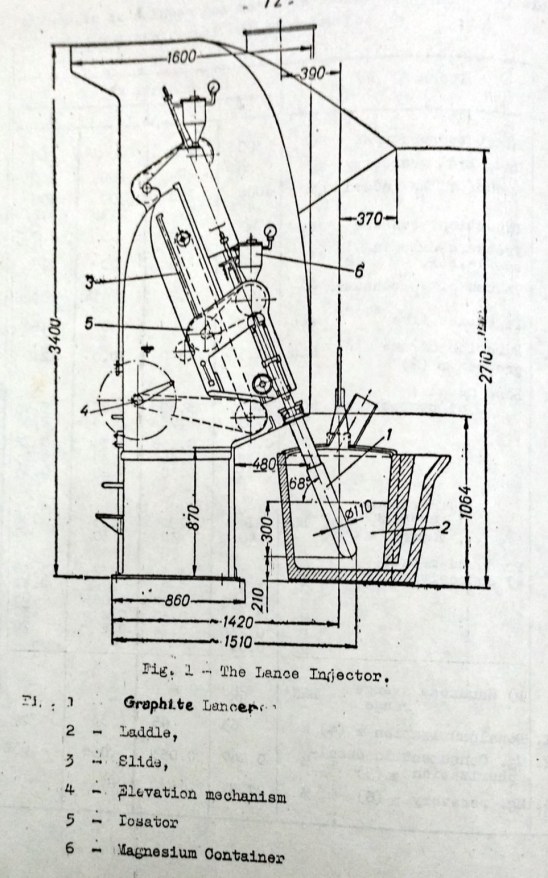
Figure 1, The Lance Injector
The operation of the lance injector was done according to the following steps:
- The magnesium container is filled with the quantity of magnesium powder required for treatment.
- The lance is connected, and the cooling air connection is made.
- The ladle is placed before the lance injector and covered.
- The cooling air supply is opened.
- The nitrogen supply is opened, and the desired pressure is adjusted.
- The lance is immersed in the melt. Magnesium feed commences automatically, and the characteristic flame of burning magnesium and the generation of magnesia fume give clear evidence of the reaction.
- When the magnesia flame disappears it is an indication that the quantity of magnesium powder has been used up. The process is then complete, and the Lance is immediately withdrawn.
- The nitrogen supply is turned off.
- The hot lance is removed from its movable support.
- Cooling air is shut off after 3-5 minutes.
Experimental melts were carried out under the following conditions:
- One Lance only has been used.
- One speed only for the dosage control motor has been chosen (about 7 gm. of Mg/sec).
- The used base cast iron for treatment is controlled according to the daily foundry needs.
- A special cover was made for an ordinary open ladle to be used during magnesium addition.
- Samples of the shape in figure 2 were caste vertically in green sand molds.
- No change was happened on the usual pouring and casting technique on the foundry floor.

Fig. 2, Test Sample
RESULTS & DISCUSSION
-
Cast Iron Desuphurization:
Due to the high relative content of sulfur in the used coke for the cupola charge which causes high sulfur pick-up to the molten iron. Also the amount of returned cast scrap, which varies between 33.5 to 45% from the charge, causes more sulfur concentration in the melted iron. Desulphurization was tried in the cupola furnace, to study:
-
Effect of blast temperature:
The results obtained were recorded in table 1. It is shown from the curve of figure 3, that, sulfur decreases with the increase of cupola blast temperature. An extrapolation for the line of fig.3 gives sulfur content 05% at a blast temperature of about 420 °C. This supports the idea of more fluid slag increases the solubility of sulfur in it, as hot blast rises the temperature of slag and consequently its fluidity.

Table 1: Effect of blast temperature on the chemical composition of the produced cast iron.
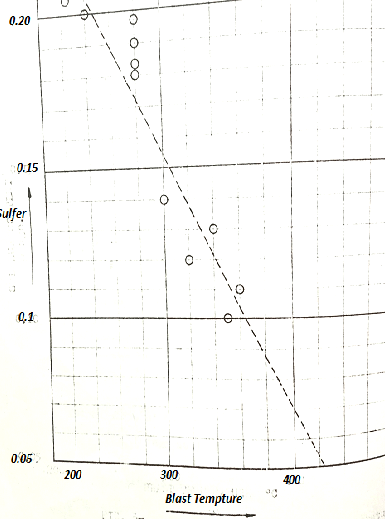
Fig. 3, Effect of blast temperature on Sulfur content
2. Effect of slag basicity:
From table (1) it is seen that the slag basicity (CaO/si02) within the range of 1.12-1.35 has, no noticeable effect on sulfur removal (refer to table # 1). Moreover, more addition of calcium carbonate has its harmful effect on the furnace lining.
3. Effect of slag fluidity:
This was carried out by adding 2 kg of flurospar to each charge, for 14 continuous charges. The fluidity of slag was measured by the die shown in fig. 4, slag was poured directly from the furnace into the round hole until it stops in the channel, and the length filled with slag is measured. Slag fluidity increases about 66%, and basicity increases from 1.55 to 1.76 (about 15%). A drop in sulfur content from 0.167% to 0.140% has been obtained. One difficulty has been observed, which is the quick attack of furnace lining.
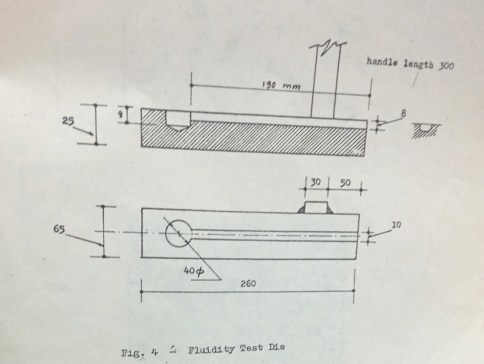
Fig. 4, Slag Fluidity test die
4. Treatment of Cast Iron by Magnesium Powder using the Lance Injector:
Changing the amount of magnesium injected, under the existing conditions of the foundry. The characteristic of each experiment and its results are tabulated in table 2 in which the following notations are observed:

Table 2, Experiment characteristics and results of magnesium powder injection by the lance injector
-
-
- QN2 = P X Vbottle where Vbottle == 0.053 M3
- Duration of the process; is the time consumed from filling the ladle from the receiver to pouring the samples.
- Hardness range; is the difference in hardness between the center of 25 mm. round sample and 2 min, from its edge
- Depressurization = [(Sinitial – Sfinal ) / Sinitial] Χ 100
- Mg %age. consumed in desulphurization = 0.75 (Sinitial – Sfinal )
- Mg recovery% = [0.75 ($initial – S final) + Mg residual] / Mg added] X 100
-
The successful result of experiment No. 1 gives complete nodularity of the graphite part of its carbon, As shown in figure 5, (X 100 un-etched) there are two types of nodules, that of maximum diameter of 40 micron, and other of diameter 25 micron and less. Figure 6 from the same melt, etched in 4% nital (nitric acid) at magnification 300, which shows graphite nodules on a pearlite matrix, with some areas of cementite due to the relative high manganese, content, which leads to higher hardness.
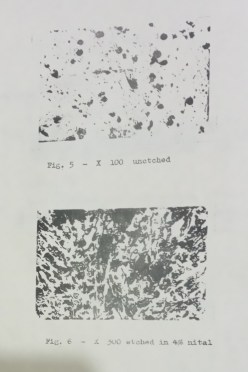
Fig. 5 (X100)
Fig. 6 (X300)
As the blowing with nitrogen had its cooling effect on the melt, it is interesting to calculate the drop in temperature due to nitrogen blowing. A thermodynamic calculation has been made, assuming the following data:
- Initial metal temperature 1300 °C
- Specific heat of molten cast iron = 0.167 K. Cal/kg. °C
- Specific heat of nitrogen gas at temp. 1300 °C = 8.073 Cal/ deg.mol.
- Weight of treated cast iron 100,150,200 & 300 kg.
- Results were blotted on the curves of figure 7.
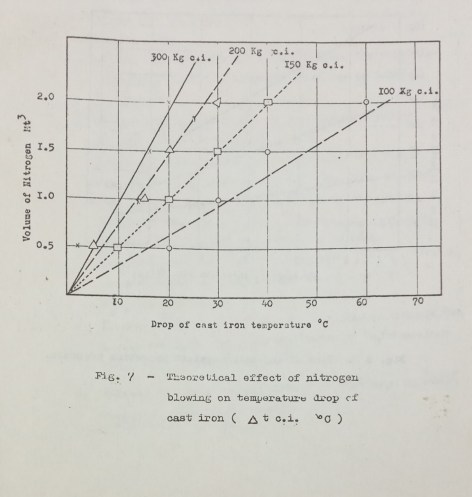
Fig/ 7 : Theoretical effect of Nitrogen blowing on temperature
drop of cast iron ( Δt C.I. C0 )
Beside the drop of temperature to the blowing of nitrogen, the time taken in injection has also an effect. To investigate the needed time to blow certain amount of magnesium powder, the following practical test was carried out:
- The dosage control gear operates at its maximum speed.
- An amount of 250, 500 & 750 gm. of magnesium powder was blow.
- Time of injection was measured under different pressures.
- The results obtained were plotted on figure 8.
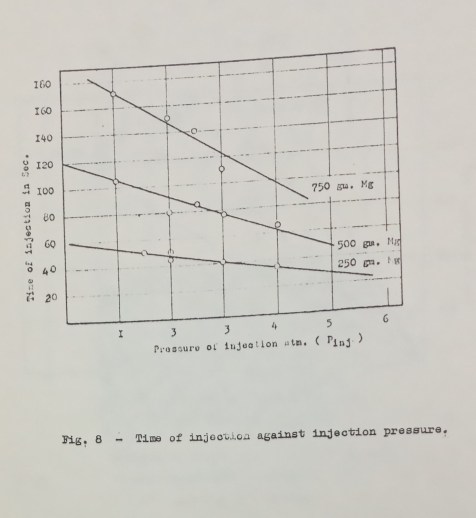 Fig. 8 Time of injection against injection pressure.
CONCLUSION
- The high sulfur content in the base cast iron can be decreased by increasing the cupola blast temperature from 300 “C to 500 °C, or by using low sulfur coke.
- The slag basicity, or fluidity has low effect on the desulfurization, as the used cupola has neutral lining.
- Ladle treatment, to drop sulfur till about 0.05% can be applied, but a mixing ladle, or a rotating receiver for the cupola, in which the desulfurizing agent is added should be used.
- The treatment of cast iron by injection of 4 kg magnesium powder per ton iron, with nitrogen as a carrier gas, gives good results, in-spite of the bad conditions of base cast iron.
- A large drop in metal temperature after treatment always happens, due to nitrogen blowing, and the process itself. So, it is preferable to add 10-15% of liquid hot cast iron after treatment, to insure hotter modified metal for pouring parts with thin wall thickness.
- As a mechanical aggregate the Lance Injector always needs continuous maintenance and suitable repair, also the problem of lance blocking has a bad effect on work continuity.
REFERENCES
- H. Jangh Bluth, and K. stock Kamp, “Chemical Reactions in the cupola”, Foundry Trade Journal Vol, 99/0ctober 6 & 13, 1965.
- Bchuman Eberhard, “Metallurgical changes for desulpherization of cast iron metals”, Giesserei 57 (1970) № 1 р.5-12,
- Dr. Erich K. Modl, “Comparing Processes for Making Ductile Iron”, Foundry/July 1970.
- H. Morrogh, “Nodular Graphite Structure”, B.C.I.R.A Journal Research and Development, 1950, III, 251-298.
- P.H. Buttner, H.F, Taylor and J. Wulff, “Graphite Nodules,” American Foundry 1991 October 49-50
- Стеним ни условия получение и литя Высокопрочного вязкого чусуна, издо Дома цы женыри и техники им. Ф.Э. Озержинского, Москва, 1954.
- Гирович н.г. в чужую с пластичныма Свойствами взамен сталы и цветных сплавов, мнинград, 1951.
- Ващенко к.н., Софрона л., Чугун, Малигиз, кіб7. Магниевый ,1967

 Human Performance Improvement for you